Questions and Answers
LP - Lata Pada
Q - Question
Q: In collaborating with this group, did you work on a specific idea together, and how?
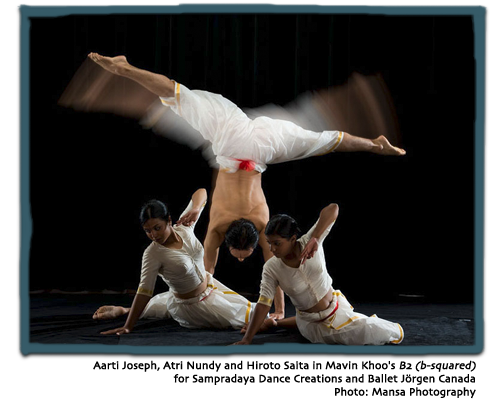
LP: The inspiration came from Bengt and I being curious about working with two classical forms. But in terms of the choreographic content and the approach and the movements, they came completely from British-based choreographer and dancer Mavin Khoo.
Q: And your part in this was? It was his choreography?
LP: It was his choreography. We had commissioned him to do it. And four of my dancers were in it. And you know I was careful of who I chose because, as I said, I am not interested in superficial examination of what ballet is and what Bharatanatyam is. I needed someone who embodied the performance to be able to be in that work.
Interestingly, there are two distinct sections to the music and it's a long piece. There's one part that really talked about the whole metaphor of the goddess Shiva in that work, and the metaphor of Krishna is in the second work, but so completely abstract that it's hard to see. But the words of the song were both sacred hymns that were being sung. In the Krishna piece he was looking at sexuality. He was looking at the delicacy of human relationships and in the Shiva piece he was looking at androgyny. He was looking at the conflict between power and lightness and dark. That's what his choreographic approach was.
Q: Why weren't they wearing the ankle bells?
LP: In this last piece? That was Mavin's choice not to use bells. I suppose he saw this as a contemporary work and he thought that he could break the rules. Many choreographers, if they're working with a traditional repertoire will use them. Quite often, when I am doing a new work which I see as something contemporary for the form, I choose not to use bells. But definitely for traditional work I do. Definitely. It's a choreographic choice, I suppose.
Q: Can you describe some of the circumstances of the renaissance of Bharatanatyam?
LP: In the 1940s Rukmini Devi Arundale set up the institute of Kalakshetra in South India. She was quite a revolutionary person. She in fact revived Bharatanatyam to a certain extent because of her association with Anna Pavlova. When Anna Pavlova visited India, Rukmini Arundale expressed an interest in the ballet, and that's when Anna Pavlova said, “You have such a rich tradition here in India, why have you not considered working in that form?” And I think that was a turning point in her life and she then established this institution, which is one of India's premiere institutions for Bharatanatyam.
Q: This using traditional elements ... do you see other people in the world working like this?
LP: That's something that is happening globally. It's part of the new tradition. I have a colleague in Australia who has worked in Bharatanatyam with the aboriginal people in Australia. I have another colleague in South Africa who has worked in South African dance traditions and they've all committed a lot of time. It's not something they just put together. It's quite a trend and this whole notion of exploring the transnational in dance has become a very strong impact for choreography.
Q: And do you have an idea why it might be a trend at this point?
LP: Some choreographers recreate the mythological stories and personalize the work – in other words try to keep it within the framework of the narrative tradition that we're accustomed to. Some of them actually challenge those stories, and try to find other layers of meaning. For example there's a story of Draupadi who is a very central figure in the Mahabharata and, to cut the story short, there was a great feud between two families – not unlike Romeo and Juliet – but Draupadi was married to the Pandavas princess and here again there is a story. She was married to five men; there was a strange set of circumstances – she had to marry five brothers. So there's a huge rivalry between them and cousins on one side, and they play a monumental game of dice. If anybody has seen Peter Brook's Mahabharata, that game of dice is very central to the narrative. In that game, Draupadi is staked as one of the pawns and they lose the game, so the opposite rivalry decides that this is the time to humiliate her in this crowded court and take their revenge. You see this narrative played over and over again in Indian dance whether it's Odissi, Kathak, Bharatanatyam. Her sari is pulled off her and it's her sheer devotion to the god Krishna who intervenes and mysteriously offers her an endless supply of fabric so she never gets completely de-robed.
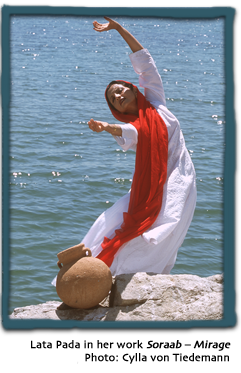
Now this is a very important narrative, but many contemporary dancers have taken it to also explore the notion of mother earth being stripped of her dignity. Draupadi becomes a metaphor for our earth and for our environment, and how we are callously eroding our natural resources. There are different ways in which you can find your personal narrative within. I completed a work called Soraab - Mirage and it was based on my friendship with an Afghan girl when I was going to school in India. When we were in school, she talked about Afghanistan, which is such a beautiful country; we had a really strong friendship. Mysteriously one day she didn't come back to school and we never knew what happened to her. Apparently, she had to return to Afghanistan to get married and I never met her again. I have no idea where she is. About the time that we were hearing about the atrocities of the Taliban against women, it was her face that kept coming back to me in everything I read. That propelled me to create a new work on my friendship with her and through that the narrative of the segregation of women in that particular part of the world.
 Q: Can you talk about your use of text in Revealed by Fire?
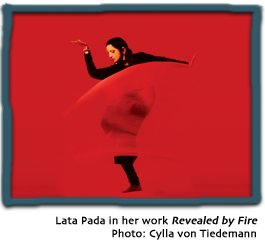
LP: Use of text in Revealed by Fire actually came about because of my collaboration with Judith Rudakoff who is a professor of theatre studies at York. She was my dramaturg for that entire work. The text that was used was based on a series of interviews that she recorded, and from that she pulled certain words and phrases. One of them had a huge impact, though we really never intended to craft it for the work. It was just conversation, but I was talking about how a woman's identity is so based on a patriarchal system that you're always somebody's daughter, you're always somebody's wife, you're somebody's mother. And when do women then have their own independent identities that are not connected to outside issues. I just said it to her. I've been frustrated. If I lose my husband am I still a wife? If I lose my children am I still a mother? And she found that so powerful that she said it absolutely needed to be included in the text; so the whole work actually does have some text. Also, I collaborated with Cylla von Tiedemann who's an incredible photographer. She travelled with me to India and the images were quite amazing.
Q: I'm just wondering: for that piece, or for something that is so personal and so emotional, how do you take the dancers through the process to embody its meaning?
LP: That was a difficult journey for them. They of course knew me, because they were all dancers who trained with me, and they knew of my personal background, but it was a totally different story to let them enter the work. Parts of the piece had a huge amount of physical contact where their presences on the stage were really the forces of society pushing me down and not giving me the space to emerge. They were pretty uncomfortable doing it because it needed an aggression they were not accustomed to. In fact, on the stage when I was at my most vulnerable, they found it difficult. But we had a lot of sessions where we just talked, and talked, and talked, and I spent a lot of time showing them photographs of my family, showing them media reports of the Air India tragedy. I talked about the mythology that I was referring to; I showed them – we had a huge collection of images from that trip – the log of our journey through India, and talked about issues regarding women. The interesting thing in India is that the goddess is a very important phenomenon. The goddess is venerated as mother, as the one who gives life, gives sustenance – and yet there's such a paradox in the fact that women have to endure certain societal attitudes. There's a disconnect, and that was one of the things I was very keen to express in this work. So the metaphor of the goddess is a very important image. It comes up repeatedly through the work.
Q: You just mentioned that you worked with a dramaturg for this. Do you work with a dramaturg for all your pieces, or just this one?
LP: That was the first time I worked with a dramaturg, and I also worked with Judith Rudakoff for Soraab. I haven't necessarily used a dramaturg in all my work, but for that particular one I did. And I really benefited from it because part of the difficulty was trying to figure out how I could universalize a personal story; for me it was important that one did not just see a personal story being acted out on the stage. It then only remains a personal story. For me, the discussions I had with Judith were largely about how this story could touch anyone in the audience, and perhaps relate to something that they might have experienced themselves. So it was really important to put it in a broader and more universal context.
 Q: Is there tension in creating traditionally and non-traditionally?
LP: In India there still is conflict, more and more, because there are articulate choreographers and dancers creating the work and they are able to speak to the incentives for that work. People are beginning to understand that it's not a desire to be contemporary for the sake of being contemporary. Or that we are not necessarily being influenced by trends that might be from outside India. All the contemporary work that is being created in India is coming from a very strong social/cultural point that remains Indian. It's not adapting new movement which is from Western forms. Or, we may use devices that are from other forms but the inspiration of the piece, the source of the piece and the reason why it's important for that artist, is often articulated as coming from a very strong centre which is India in aesthetic and in people and in intent. But my guru, for instance, who's now in his late 70s, is definitely not ever going to approve of very contemporary work within his own institution. But he understands there's a reason why I do it. And it could largely be because I live in Canada. I might not have done it if I had been in India. But I think I have convinced him that I work in contemporary areas without ever giving up the strength of the tradition, the classical form. So my company is really strong in both its traditional and contemporary repertoire. We haven't given up one for the other at all. So I think he's somewhat reassured by that. In cities like Chennai, which is in South India, a large amount of Bharatanatyam is performed. I know they don't take very well to contemporary work. We're now touring with two works. One is the classical piece that you saw and the other work that I didn't show you is a new work on the sport of cricket which is very British, very colonial, and the sport has come to Canada as well. In Chennai, where I'm doing my performance, they didn't want that work, they only wanted the classical work. And that's fine.
Q: How have Indian dancers and teachers felt when other people are training in the form and representing the form?
LP: There's a lot of networking between artists who live in India and outside. We go to conferences in India. People from India come to conferences here. In fact, in January next year there's going to be a really important Kalanidhi Festival on contemporary Indian dance, so please look out for it. It's going to be quite a wonderful event.
Also, by the way, we are performing a piece on the 31st of January. It's a new work that I didn't show you. It's called Shunya, and is based on the concept of “zero” and “voice” in different world cultures, again very abstracted.
In India, initially, there was a sense that those who practice a form in the diaspora are really not serious about it, they are diluting the form and playing with it. But I think the Indian diaspora in North America is very mature. We've been around for 40 years. We've been working hard at our art and they've now begun to understand that there is a seriousness and credibility to the work that we do.
Kalakshetra, in South India, is the largest institution for Bharatanatyam and draws the most foreign students. They come from every part of the world to study at Kalakshetra. Many of them have spent decades in India committing themselves to the study of this art form with great sincerity and hard work. So we're not unaccustomed to that. In India we regularly see serious artists on the stage who are not South Asian.
Q: How does one develop movement for contemporary choreography?
LP: It is a very interesting question. In a classical form it's not too difficult to create sections of dance based on our traditional vocabulary and the appropriate treatment of the lyrics or the music that that music relates to. So it's easier when I create traditional choreography. When it's contemporary choreography I have to give myself twice as much time in the studio and a lot of it results from a huge amount of improvisation and just working it – trying and trying. It takes very much longer because the form has very prescribed movements and we really configure it in different ways, but there is a structure to work within, whereas with contemporary dance there's no structure.
The last work that I created, Shunya, I created in the absence of music, which I found really difficult to do. I did this partly because the composer was still in India and he said, “Don't worry. Create the dance, and I'll figure it all out.” And it was really difficult because I am very compelled by music and rhythm in my work. But it turned out to be the most fascinating exercise because I opened myself up in a way I wouldn't have, and it actually brought up a huge lot of possibilities that I had not imagined.

home l shop dcd l history l links l donations l the collection l services l shipping policy l CIDD l exhibitions l CDFTP
educational resources l visits & lectures l making archival donations l grassroots archiving strategy l personnel l RWB alumni